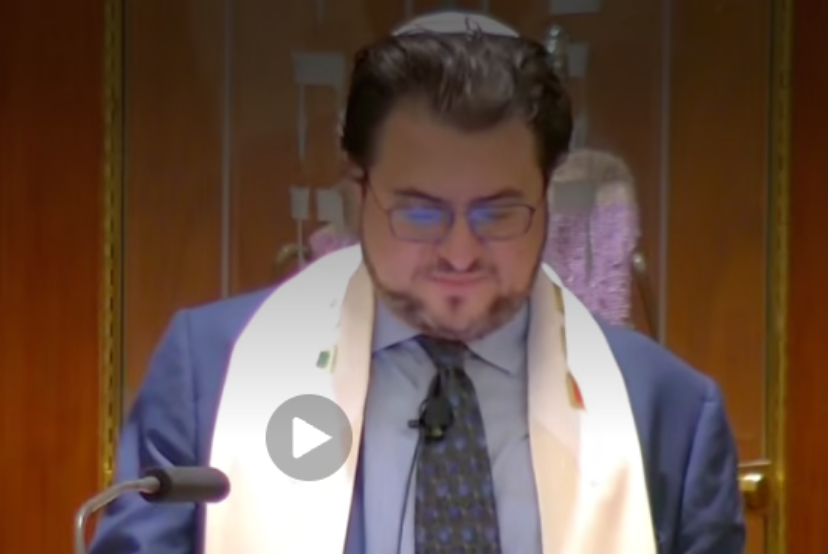
Adapted from Rabbi Josh Fixler’s October 23, 2026, sermon, “Lech L’cha—Go Vote,” at Congregation Emanu El.
Your vote won’t fix everything. But that doesn’t mean it can’t do something.
Rabbi Josh Fixler connects an ancient call with a responsibility we share today. God’s invitation to Abraham—go, leave the familiar, move toward a future you cannot yet see—becomes a call to participate in shaping our own future. Not because we can finish the work ourselves, but because we have a part in it.
Watch the full sermon on our website or listen on The Voices of Emanu El podcast.
Many of us think of ourselves as people who vote. We care about our communities. We intend to participate. Then life happens: work, family, a busy schedule, a long line.
Rabbi Fixler names the space between thinking of ourselves as voters and actually casting a ballot. Emanu El’s nonpartisan voter-engagement work helps members close that gap through congregant-to-congregant conversations. The goal is not to tell anyone whom to vote for. It is to help each person make a plan and follow through.
That plan begins with a few specific questions:
“It’s not just enough to want it,” Rabbi Fixler reminds us. A commitment becomes more concrete when we decide what taking action will look like.
Sometimes the obstacle is not a crowded calendar. It is the feeling that our contribution cannot possibly matter.
If one vote cannot solve every problem, why bother?
Rabbi Fixler identifies that response as all-or-nothing thinking: the belief that if we cannot do everything, there is little point in doing anything. He turns to Abraham’s story for a different way of understanding our responsibility.
Before Abraham receives the call of lech l’cha, his father, Terach, has already begun moving the family toward Canaan. They reach Haran and settle there, short of their destination. In Rabbi Fixler’s reading, Abraham’s journey is not simply a departure into the unknown. It is also the continuation of a journey his father began—a chance to carry forward an unfinished dream.
Our work, too, can begin before us and continue after us. We do not have to reach the destination alone for our steps to matter.
Rabbi Fixler draws on Rabbi Tarfon’s teaching in Pirkei Avot:
“It is not up to you to complete the work, but nor are you free to desist from it.”
This, he explains, is Judaism’s answer to all-or-nothing thinking. Some tasks are too great for one person. Some cannot be completed in a single generation. Still, we contribute—with faith that our efforts will join those of our parents, our children, and people we may never meet.
Voting becomes one expression of that shared responsibility. It does not require certainty that a single ballot will accomplish everything we hope for. It asks us to participate in something larger than ourselves.
As Rabbi Fixler puts it:
“It’s true that your vote will not fix everything, but it will do something, especially when combined with millions of others; each tiny drop that makes up an ocean.”
Near the sermon’s conclusion, Rabbi Fixler turns to “Shir l’Shalom,” “Song of Peace,” and its invitation: Don’t just say the day will come. Help bring it.
The words haviu et hayom—“bring on the day”—connect the hope for a better tomorrow with the responsibility to act today. Rabbi Fixler describes our vote as a prayer: an expression of hope, collective power, and faith that we can build what earlier generations only dreamed of.
At the conclusion of the sermon, Cantor Rollin Simmons sings “Shir l’Shalom,” giving musical voice to the invitation Rabbi Fixler has shared.
The call is not to do everything. It is to take the next step.
If you have already voted, thank you. If you have not, make your plan. Make your voice heard.
Lech l’cha. Go.
Explore Rabbi Josh Fixler’s full message in “Lech L’cha—Go Vote.”